The Nature of Art
Presented by Coral Gallery
Booth 711
“A work of art encountered as a work of art is an experience, not a statement or an answer to a question. Art is not only about something; it is something. A work of art is a thing in the world, not just a text or commentary on the world.” — Susan Sontag, Against Interpretation —
The nature of art is a subject that has been debated for centuries and remains an enigma. The original split between nature and culture is the basic postulate that makes us human, but it is also what drives us to seek a connection with nature through art.
Artistic practices, like religious ones, are variations on an attempt to suture the gap between nature and culture, and Roberto Vivo’s work is an example of how art can be used to explore this relationship and find new ways of connecting with nature.
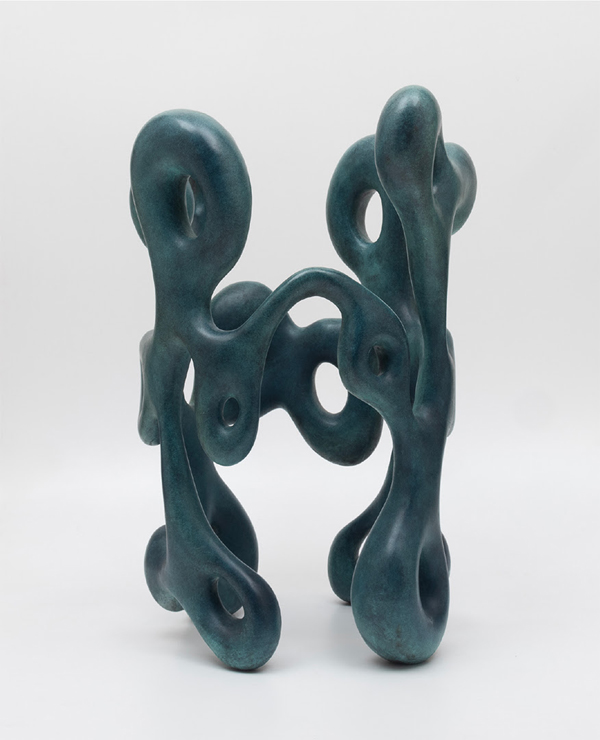
In his works, Roberto Vivo establishes a deliberate break with history, as he dispenses with references that date his view and restores forms to their primary and pristine character. In this way, he manages to reformulate the question about classical art or, better said, about what we call classical in art. That is to say, that enigmatic characteristic that transcends anchorage in an era and that continues to question where the conditions of existence that sustained the concretion and meaning of a work of art have disappeared. The action of time thus becomes superfluous in its cruel exercise of peremptory expiration over each period of life. And it forces us to think in terms of a method of interpretation that accounts for that zone of aesthetic perception that escapes the rhetorical webs of each present.
Vivo’s production evokes the boldness, and the formal and compositional freshness, of Henri Matisse’s famous cut-outs, for which the French artist cut out shapes from colored paper and arranged them on other sheets that he laid out in his studio. Characteristic of Matisse’s last creative stage, these collages composed of irregular and colorful cut-outs, similar to vegetal or floral motifs, resonate in Vivo’s works. But, in Vivo’s case, he carries them to three-dimensionality, dynamizing the forms and rendering them corporeal.
Inquiring into the essential elements that nature and art share is at the core of Vivo’s research. Form, color, volume and texture come into play in the spatiotemporal dimensions in which his works unfold. The artist appears to hide the coordinates that give rise to his designs, at times organic, at times fantastic. We observe them in a here and now, as a snapshot event that might continue to develop and grow in our absence.
In a gesture of apparent innocence, of attachment to the playful possibilities of creation, Roberto Vivo deliberately strips his works of the urgency of context, of reference and of historicity, thus offering the viewer the opportunity to approach the game of sensitive contemplation and experience without prejudice.